Introduction
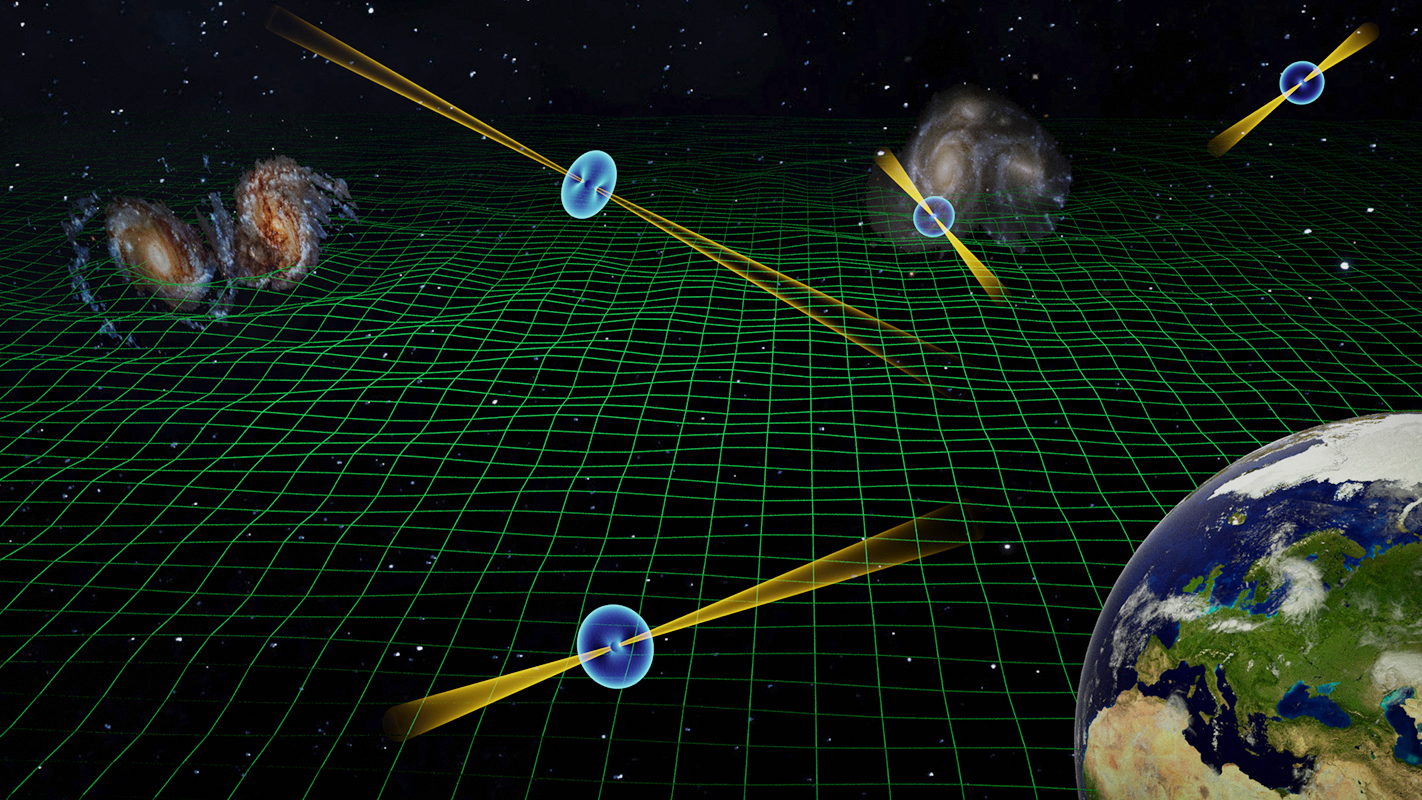
When massive astronomical objects merge, such as black holes or a black hole and neutron star, they produce gravitational waves: ripples that travel through spacetime and induce an extremely small strain in matter as they pass.
Gravitational waves provide information about phenomena that are not always available through electromagnetic observations. Signals associated with supermassive black-hole binaries can help us investigate both the population of those objects and the evolution of the wider universe.
The first detections—and the frequency gap
The first direct observation of gravitational waves was made by Advanced LIGO in 2015, confirming a century-old prediction. LIGO measures relative changes in length, or strain, of order 10⁻²¹ and below.
The gravitational-wave spectrum spans an enormous range. The nanohertz band corresponds to periods of years or decades and is inaccessible to ground-based interferometers in practice: environmental motion and other low-frequency noise sources dominate their sensitivity.
Competing approaches
Space-based detectors offer a different part of the spectrum. LISA is a planned millihertz observatory using three spacecraft separated by roughly 2.5 million kilometres, measuring changes in their separation as a wave passes.
Cosmic Microwave Background observations seek possible imprints of primordial gravitational waves at still lower frequencies. These probes are complementary rather than substitutes for the nanohertz measurements made with pulsar timing arrays.
Pulsar timing arrays as galactic detectors
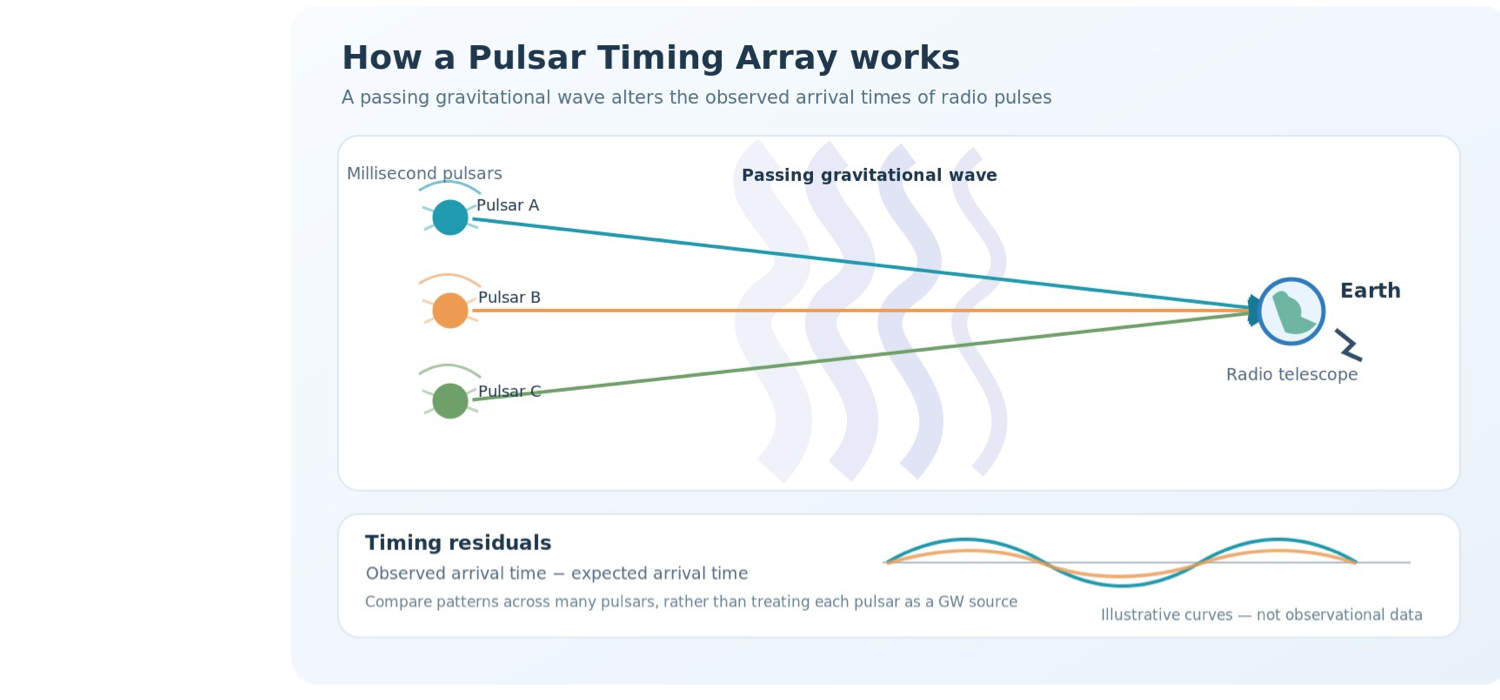
Pulsar Timing Arrays (PTAs) use rapidly spinning neutron stars as exceptionally regular galactic clocks. A passing gravitational-wave background changes the expected arrival times of their radio pulses; comparing timing residuals across many pulsars makes correlated disturbances measurable.
In 2023, the NANOGrav collaboration reported evidence for a nanohertz gravitational-wave background from 15 years of observations of 67 pulsars. The correlations followed the Hellings–Downs pattern expected from such a background.
The remaining obstacle
One expected source of the nanohertz background is the combined contribution of inspiralling supermassive black-hole binaries. Other astrophysical and early-universe processes may also contribute. None of the primordial contributions has been established in PTA observations, making weaker components of different origin difficult to isolate.
Longer baselines and improving sensitivity will also make it possible to test anisotropy: whether the background varies slightly across the sky because supermassive black-hole binaries are not distributed uniformly. The NANOGrav 15-year analysis constrained anisotropy but did not find significant evidence for it.